When a JennAir gas burner will not ignite, the first things to look at are moisture, clogged ports, burner parts that are not seated, and a control lockout after a power loss.
When a JennAir gas burner will not ignite, the first things to look at are moisture, clogged ports, burner parts that are not seated, and a control lockout after a power loss. If there is a persistent gas odor, stop testing and leave the area before anything else. Otherwise, clean and dry what you can reach on a cool cooktop, then book service if the burner still will not light.
JennAir Gas Cooktop Burner Will Not Ignite: Safe Checks and Stop Conditions needs a safety-first approach. The objective is to collect only the external information that can be observed safely and stop before repeated testing increases gas, electrical, water, heat, or mechanical risk.
Do not change several conditions at once. If power is reset, settings are changed, filters are cleaned, and the appliance is moved in the same attempt, the evidence becomes harder to interpret.
| Symptom | What it can point to | What you can check |
|---|---|---|
| Clicking but no flame | Control Lockout active after a power loss, or moisture in the burner ports or switches | Unlock the controls, then let a wet burner dry fully; a cool hair dryer can help |
| Burner lit once, then not again after cleaning | Cap or ports wet, or burner parts not sitting correctly | After the burner cools, dry and reseat the removable parts |
| Continuous sparking even though a flame appears | On downdraft models, airflow blowing the flame away from the igniter | Lower the downdraft blower speed or raise the flame setting |
| No burner lights on a new or recently moved cooktop | Air in the gas lines on first use, or the gas shut-off closed | Turn on any one burner to let air release; confirm the gas shut-off is open |
| Gas smell that does not go away | A gas leak, which is not an ignition problem | Stop testing, do not use the cooktop, and follow gas-safety guidance |
JennAir cooktops and rangetops include gas, electric/induction, and downdraft configurations. For induction, cookware compatibility and zone pattern matter; for gas, cap position, ignition behavior, and gas-safety boundaries matter. Identify the exact zone/burner and compare another one under normal conditions.
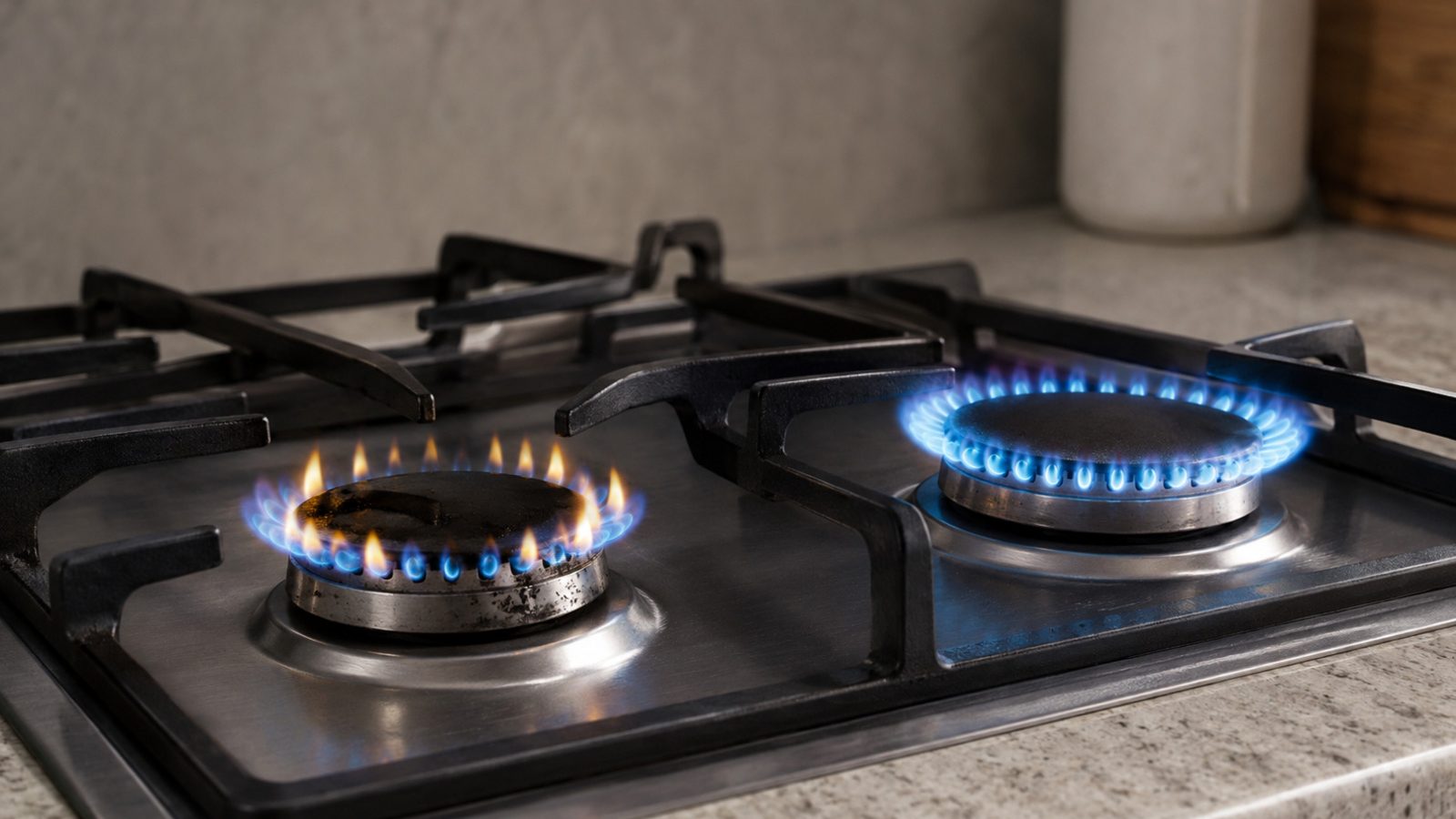
A gas burner needs three things at once: a clear path for the gas, a spark at the igniter, and a stable flame. Liquid in the ports blocks the gas path, a cap sitting off-center disturbs the flame, and a lockout simply keeps the spark from running.
Clogged ports can be cleared with a straight pin rather than a wooden toothpick.
Stop normal use when there is smoke, sparking, burning electrical odor, repeated breaker trips, persistent gas odor, uncontrolled overheating, active water near electrical connections, or another condition that creates a fire, gas, electrical, flooding, or high-temperature risk. Keep homeowner checks external and manual-approved.
Gas odor changes the troubleshooting boundary immediately. Once persistent unburned gas is present, the goal is not to keep testing ignition but to stop normal use and follow appropriate safety guidance.
If every burner fails, look at what they share: the gas supply, the lockout, or power to the igniters. If one burner fails and the others light normally, the cause is local to that burner: its ports, its cap, or its own igniter circuit.
A burner that works after drying points to moisture. A burner that stays dead after drying and reseating, while its neighbors work, is a reason to let a technician test the ignition path.
A good diagnostic visit should reproduce the symptom or use your observations to select a narrow test path. Depending on the appliance, that may mean comparing temperature or sensor readings, checking a fan or pump command, confirming water flow, evaluating ignition behavior, reading stored diagnostics, checking control output, or proving that the external installation and utility conditions are normal.
The goal is not to replace the most commonly mentioned part. The goal is to identify the failed system, confirm that the proposed repair matches the exact model, and explain what work is inside the appliance repair scope.
Leave built-in, panel-ready, or tightly fitted JennAir appliances installed unless the service team specifically asks for access. Unplanned extraction can disturb cabinetry, panels, flooring, gas, water, drain, ventilation, or electrical connections and create a second problem.
If the appliance is integrated, provide access information when booking: custom panels, service elevators, gated entry, parking/loading limits, unusual cabinet clearances, or adjacent appliances that restrict service access.
Write down the complete JennAir model number, the exact symptom in one sentence, when it began, whether it is constant or intermittent, what related function still works normally, and any displayed code, message, light pattern, or alarm before power is reset. Also note recent power, water, gas, drain, ventilation, cleaning, filter, or installation events.
These details often reduce duplicate owner-level checks and help the technician arrive with a better model-specific starting point.
Do not clear codes before documenting them. Do not order a part because another JennAir owner reported a similar symptom. Do not apply one code meaning across unrelated appliance families. The site technical library must keep appliance/model context, especially for F/E-style codes that can appear on different platforms.
Avoid internal electrical testing, gas-pressure work, sealed-refrigeration work, safety-device bypassing, or microwave cabinet removal. Those steps require proper service information, tools, and training.
Clicking means the igniter is sparking, so the problem is usually with what the spark has to ignite. Moisture in the ports, a misaligned cap, or a lockout after a power loss are the owner-level things to look at first.
Not if you smell gas; stop and follow gas-safety guidance. Without any odor, dry and reseat the burner parts first instead of testing ignition over and over.
Yes. On models with a downdraft, the airflow can blow the flame away from the igniter, which causes continuous sparking. Lowering the blower speed or raising the flame setting is the documented adjustment.
For adjacent symptoms, read JennAir Wall Oven Not Heating Evenly and JennAir Oven Temperature Is Incorrect: Calibration or Repair?. The JennAir error-code directory and JennAir model directory should be used when the exact code/model context is known.
If the live production route differs from the route above, preserve the working existing slug and map the link to that URL rather than creating a duplicate page.
Induction zone silent, gas burner delayed, or glass cooktop controls flickering? We diagnose JennAir surface cooking faults carefully.
Use one normal manual-approved restart when appropriate. Record any code or message first. If the same symptom returns, repeated resets are not a repair.
Usually no. Similar symptoms can come from different components, installation conditions, or external utilities.
No. Keep homeowner checks external and model-appropriate.
Yes. JennAir has multiple product generations and appliance families. The same symptom or code can require a different diagnostic path on another platform.
A JennAir appliance that keeps tripping the breaker should not be reset again and again.
Continue readingAfter a power outage, most JennAir appliances need only the normal restart described in their manual: acknowledge the outage message, check that…
Continue readingWhen a JennAir ice maker leaks, the first question is where the water appears and whether it is near electrical parts.
Continue readingShare a few details and we’ll confirm an appointment. Prefer to talk? Call us and we’ll help right away.