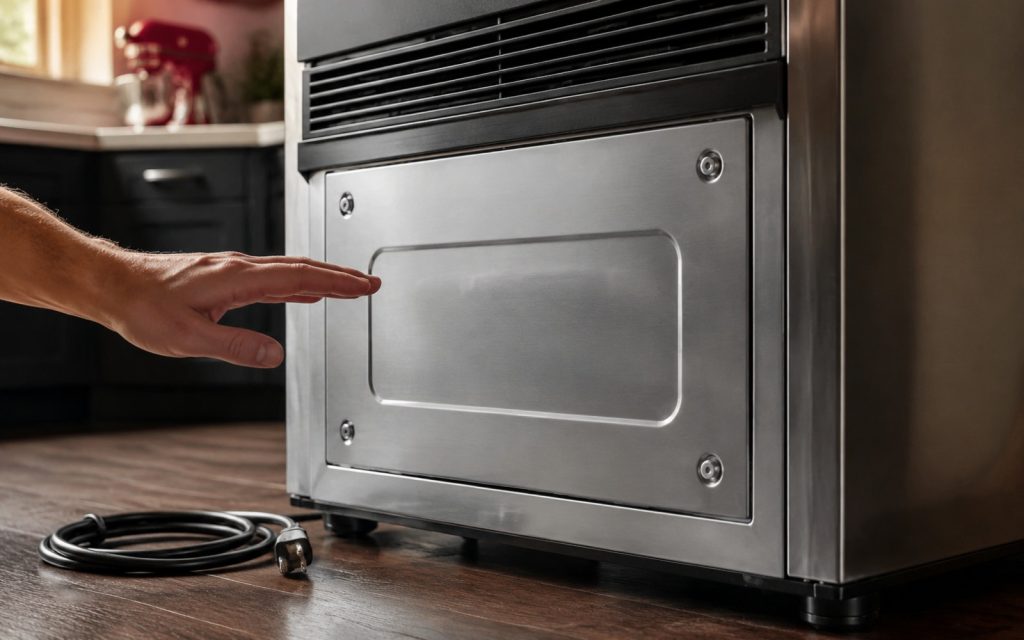
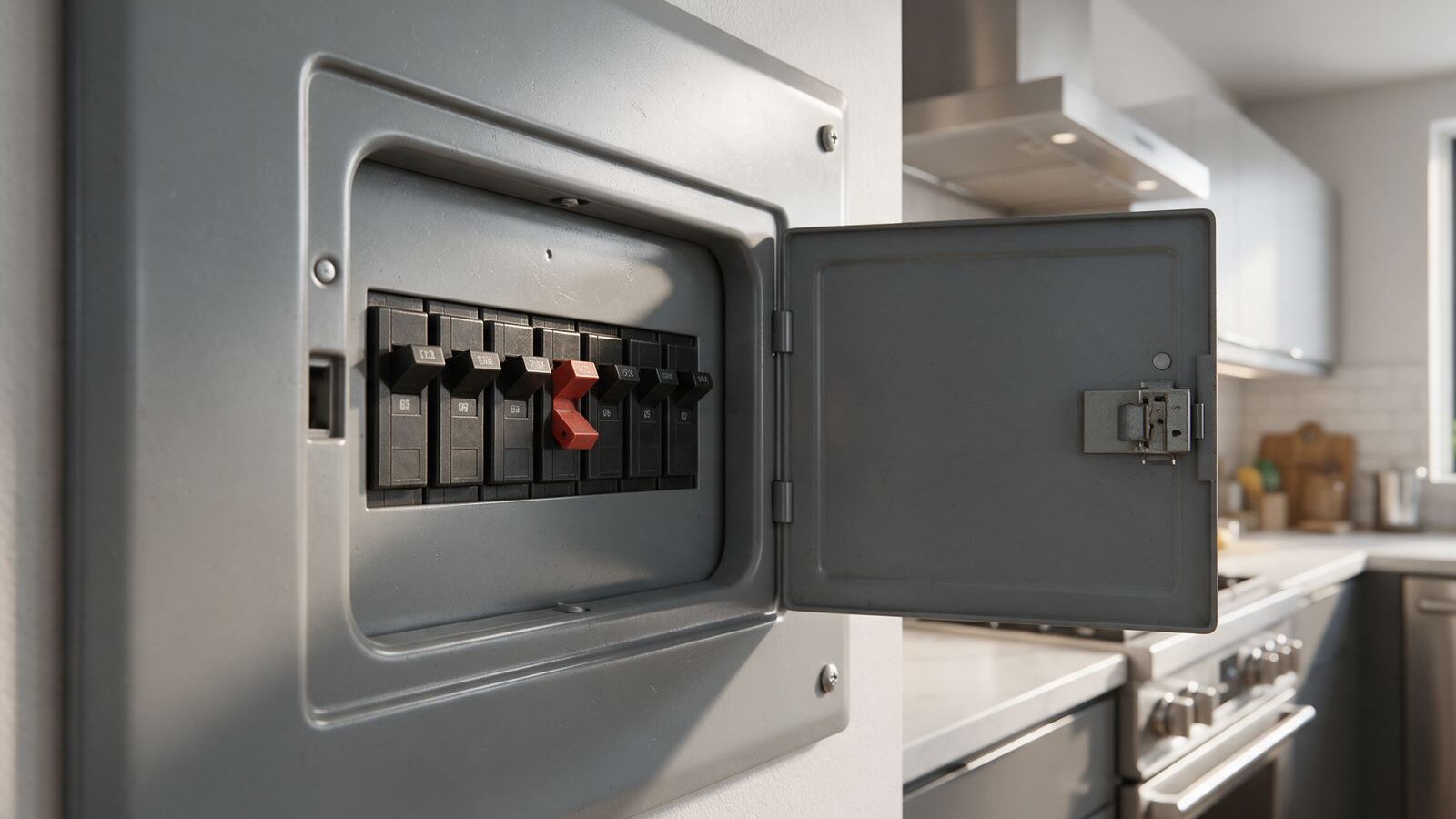
A breaker that trips when a JennAir oven, column, or cooktop runs is protecting your home. Repeated trips demand systematic respect—not bigger breakers.
When a JennAir appliance trips the same breaker again, stop using it on that circuit. Repeated resets do not fix the cause, and a breaker that keeps tripping is protecting the home. Note which appliance and which function were running, check whether a GFCI outlet is involved, and book service. If you smell burning or see scorch marks, keep power off.
Circuit breakers are not nuisances—they are guards. When a JennAir wall oven or induction rangetop trips the same breaker twice in an evening, something is drawing abnormally or leaking current to ground.
Never upsize a breaker without electrical evaluation. Never bypass protection. The correct response is isolate, observe, and diagnose.
Legitimate startup loads on ovens and compressors are brief; sustained tripping indicates ground faults, shorted elements, or failing components—not normal inrush.
Shared circuits with disposers, small appliances, or undercounter units can overload when JennAir loads coincide—installation issue presenting as appliance fault.
Water intrusion behind dishwashers or columns creates ground leaks that trip GFCI or standard breakers unpredictably until dried or repaired.
Requirements depend on the appliance. A refrigerator on many models needs a grounded, fused 115 V, 60 Hz supply at 15 or 20 amps, and a dedicated circuit is recommended. The outlet should not be switch-controlled, and extension cords should be avoided.
For wall ovens, support pages say that models at 7.3 to 9.6 kW on 240 V need a separate 40-amp circuit, and models at 7.2 kW and below need a 30-amp circuit. These are installation facts, and a licensed electrician should handle any change.
| Trip timing | Likely class | Immediate action |
|---|---|---|
| Instant on start | Hard short or severe ground fault | Leave off; schedule service |
| Mid-cycle after minutes | Heater, motor, or wire heat | Note appliance and cycle; do not reset loop |
| Random multiple appliances | Panel or neutral issue | Electrician plus appliance check |
If a breaker trips twice on the same appliance and circuit, stop using that appliance on that circuit until inspected. Repeated resets risk fire and board damage.
Smell hot plastic, see discoloration, or hear buzzing at the panel—keep everything off and call for help from a safe location.
Safe to try
Leave to a technician
Trips isolated to one appliance on its dedicated breaker lean appliance component or internal wiring. Whole-kitchen trips during multiple loads lean panel or neutral problems.
New trips after dishwasher or column leaks strongly correlate water and electricity—dry-out alone is insufficient; components need testing.
Write down which breaker tripped, what the appliance was doing, and how soon the trip followed. Check whether a GFCI outlet or the household breaker is the part that tripped.
For refrigerators, the manual suggests resetting a tripped GFCI or breaker and testing the outlet with a lamp. If the problem persists, call an electrician. For ovens, do not keep trying to operate the oven after a breaker trips again.
Two trips on the same settings mean stop—not third time lucky. Document and diagnose before energizing again.
A breaker that trips only when one function runs, such as bake or broil, points toward that function. One that trips only when several appliances run together points toward load on the circuit. A breaker that trips with nothing running is an electrician question first.
Water is a factor to rule out. A leak near a dishwasher, refrigerator or column can reach electrical connections, and drying the area does not prove the electrical parts are safe. Keep the appliance off until a technician has checked it.
Do not try to solve a repeat trip by changing the breaker or the wiring. Those are licensed electrical work, and the right order is to stop, record the pattern, and bring in the right professional.
Technicians megger and ohm test heaters, motors, and harnesses; electricians verify circuit loading and neutral integrity—we coordinate when symptoms span both domains.
Appliance service does not replace licensed electrical panel work when the fault lives upstream.
Yes. On some wall ovens, an F9 code can mean a miswired supply or power-line noise during an outage. Report it with the trip history.
No. One reset is reasonable. If the breaker trips again, call an electrician or service.
Not necessarily. A GFCI protects the circuit, and the cause could be water or a fault. Treat repeated trips as a stop condition.
Breakers trip to keep your home. Honor the two-trip rule, document timing, and bring technicians and electricians in before luck runs out.
Official manuals and support notes are available on JennAir owner support.
Write down the full model number before ordering parts. Board and sensor revisions can change which part number is correct.
A single power reset can clear a temporary fault, but repeated returns of the same code usually mean a physical cause remains.
Keep vents and filters clear between visits. Restricted airflow often mimics electrical or sensor failures.
If water, burning smells, or sparking are present, stop using the appliance and arrange a professional inspection.
No—not without wire and load analysis by a licensed electrician.
Yes—note breaker type; causes vary from arcs to ground leaks.
Often yes on bake start; some fail mid-cycle as insulation breaks down.
Not after repeat trips on the same cycle—risk is real.
A JennAir appliance that keeps tripping the breaker should not be reset again and again.
Continue readingAfter a power outage, most JennAir appliances need only the normal restart described in their manual: acknowledge the outage message, check that…
Continue readingWhen a JennAir ice maker leaks, the first question is where the water appears and whether it is near electrical parts.
Continue readingShare a few details and we’ll confirm an appointment. Prefer to talk? Call us and we’ll help right away.