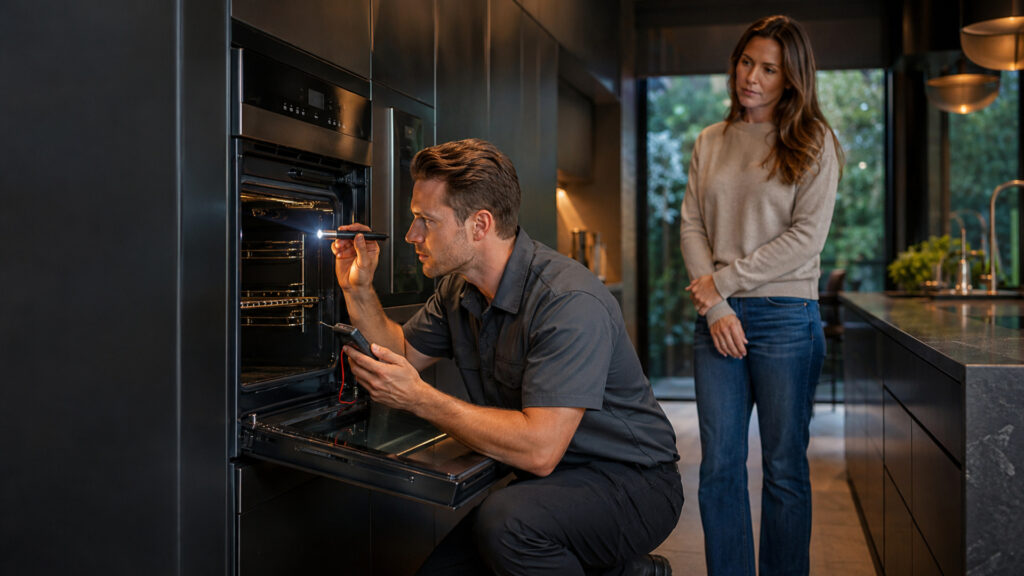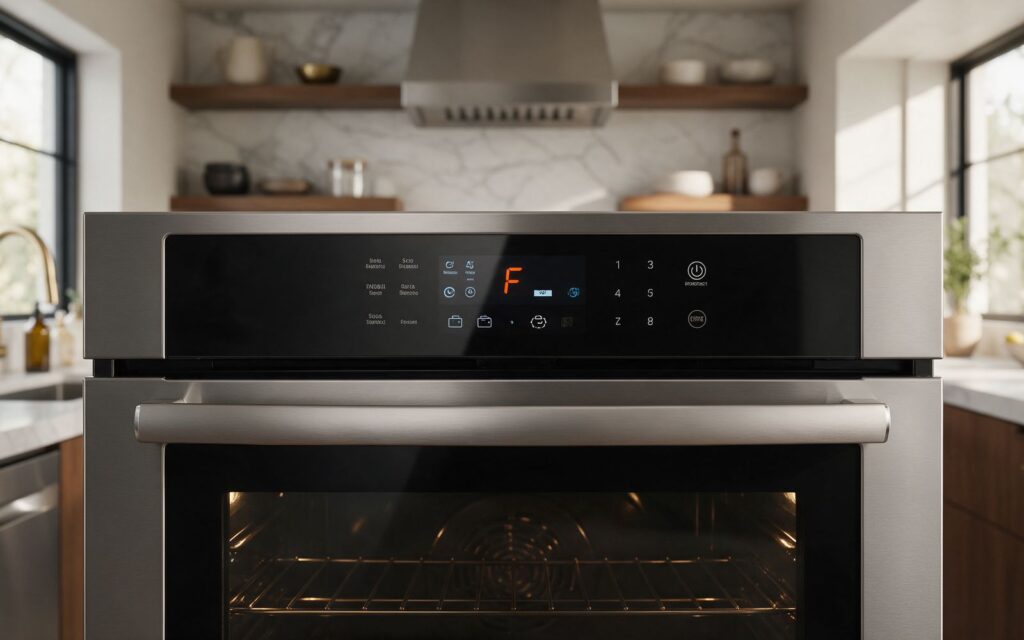
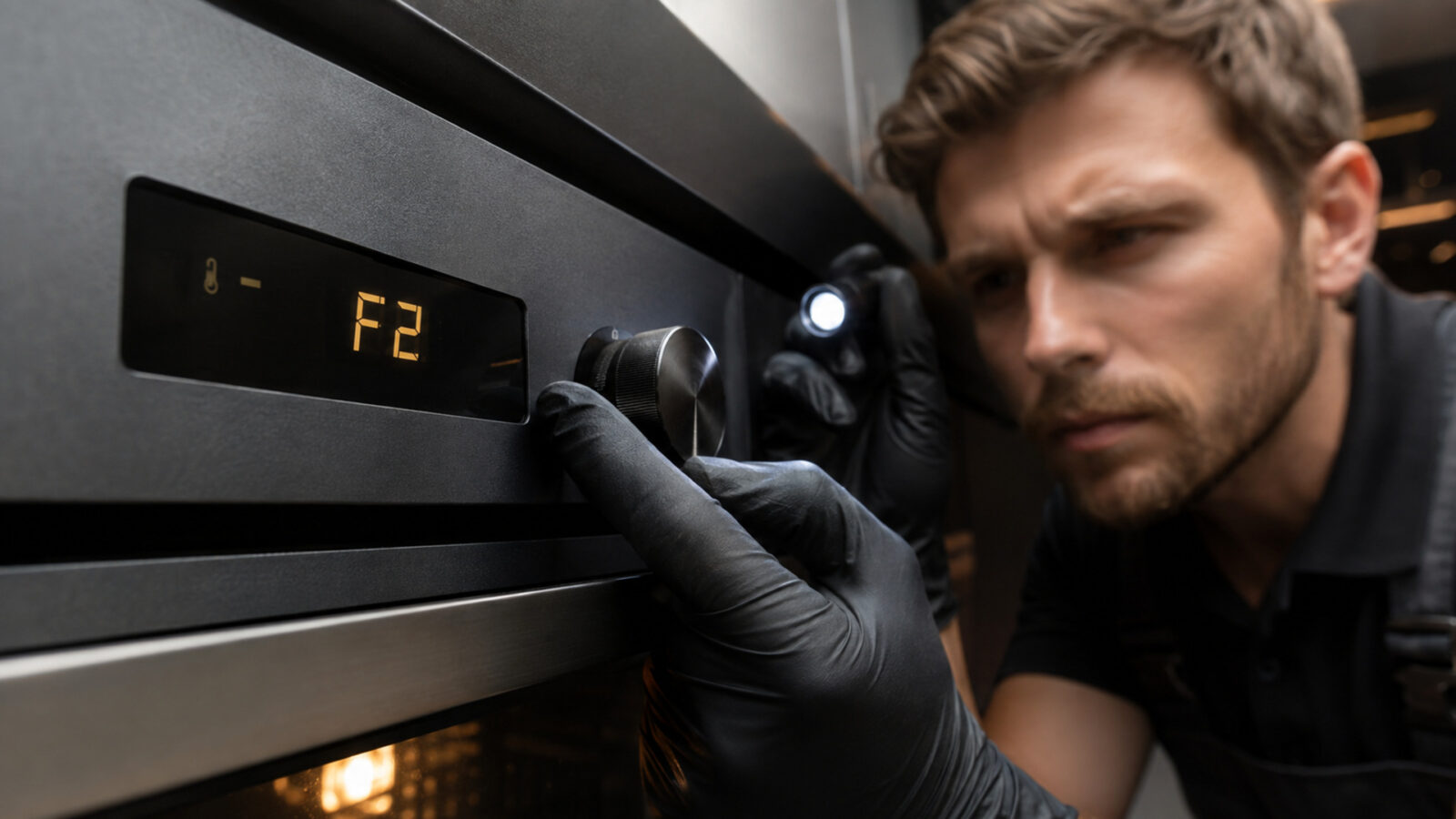
When a JennAir wall oven or column refrigerator flashes a fault code, the number is a breadcrumb—not a verdict. Learn how to read it safely before a reset wipes the trail.
A JennAir F or E code is a starting point rather than a diagnosis, and the same code can carry different meanings on different appliances. Read the code in full, including the order of letters and numbers, and keep track of which appliance showed it. The one documented reset is breaker off for one minute, then watching for about a minute to see whether the code returns; if it does, stop resetting and book.
Built-in JennAir appliances speak in brief alphanumeric bursts on the touch display or hidden service panel. A code that appears mid-roast or during a defrost cycle is the appliance trying to name a subsystem that lost confidence in itself.
Most JennAir codes fall into two families: E codes (electronic control or sensor disagreements) and F codes (functional failures such as door lock, cooling, or ignition paths). The display may show them once, blink them, or lock controls until acknowledged.
In a paneled kitchen, codes often surface after a power blip, after a long self-clean, or when a door switch fails to report fully closed. The code rarely tells you which wire—only which circuit stopped cooperating.
Clearing a code without context is like erasing a check-engine light before a road trip. Safe troubleshooting starts with capture, then correlation with recent use.
| Code pattern | Typical subsystem | What to record first |
|---|---|---|
| F9 / door-related | Latch or lock motor | Was self-clean running? Any obstruction? |
| E or F with cooling | Evaporator fan / thermistor | Freezer temp, frost pattern, recent door left open |
| Blinking display only | UI or power supply | Breaker label, other appliances on same circuit |
On JennAir cooking appliances, codes can appear as F# E# or E# F#, so the order is part of what you read. The table above shows general patterns, but the product help’s code list for cooking appliances gives some codes different readings. F9 or F9 E0 can mean a miswired supply or power-line noise during an outage there, which is why one code meaning should never be carried between appliance families.
You can gather useful evidence without opening sealed panels or touching line voltage. Treat the display as read-only until you have notes.
If the appliance is actively smoking, sparking, or smelling of hot plastic, stop and shut power at the breaker—do not chase codes first.
Safe to try
Leave to a technician
Several displays look like codes but are not. C means Celsius mode, and the display will not heat above 260. PF or a flashing time of day means a power failure occurred, and you press Cancel. LOC or Lock means control lock, SAB means Sabbath mode, and CAL means the calibration feature is active. On built-in refrigerators, a flashing PO means the freezer reached 18 degrees Fahrenheit or higher.
A code that appears once after a storm and never returns often reflects a brownout on a shared kitchen circuit. A code that returns every third bake points to a thermal switch or latch wearing out.
Panel-ready installations add another layer: a slightly proud custom panel can prevent a latch from seating, producing door codes that look electronic but are mechanical.
If the same code returns twice within a week after breaker resets, further resets only delay a proper test. Schedule diagnosis before hidden heat or cooling damage spreads.
A code that clears after a reset points to a temporary condition such as an outage, but it does not say what caused it. A code that comes back is more likely tied to a physical cause. The documented check is to restore power and watch for one minute.
Service starts with model-specific wiring diagrams and live readings at the component named by the code family—not guess-replaced boards.
Built-in ovens and columns often share circuits with downdraft or warming drawers; we confirm load and grounding before condemning a single part.
A JennAir fault code is a polite interruption. Capture it calmly, try only the checks that respect your skill boundary, and let a technician interpret what repeats.
On the cooking-appliance list in the product help, F9 or F9 E0 can point to a miswired supply or power-line noise during an outage. Meaning varies by appliance and model, so confirm against your manual.
Read it fully first. A single breaker-off reset of one minute is documented, but repeated resets only delay finding the cause.
PF or a flashing time of day means a power failure occurred. Press Cancel to clear it.
Official manuals and support notes are available on JennAir owner support.
Write down the full model number before ordering parts. Board and sensor revisions can change which part number is correct.
A single power reset can clear a temporary fault, but repeated returns of the same code usually mean a physical cause remains.
Keep vents and filters clear between visits. Restricted airflow often mimics electrical or sensor failures.
If water, burning smells, or sparking are present, stop using the appliance and arrange a professional inspection.
Sometimes, if the underlying cause was a one-time power event. Repeating codes need component-level testing.
No—not while a door or lock code is active. Self-clean adds heat to an already faulted lock path.
Yes. Codes map differently across JennAir generations; the model plate narrows the chart.
What to Expect During a JennAir Appliance Diagnostic Visit should be handled as a sequence of questions. Each safe check should confirm…
Continue readingJennAir Error Codes: How to Read F and E Codes Safely should be handled as a sequence of questions. Each safe check…
Continue readingA focused diagnostic visit on JennAir built-ins saves time and repeat trips. A little preparation turns an hour on-site into answers—not another…
Continue readingShare a few details and we’ll confirm an appointment. Prefer to talk? Call us and we’ll help right away.