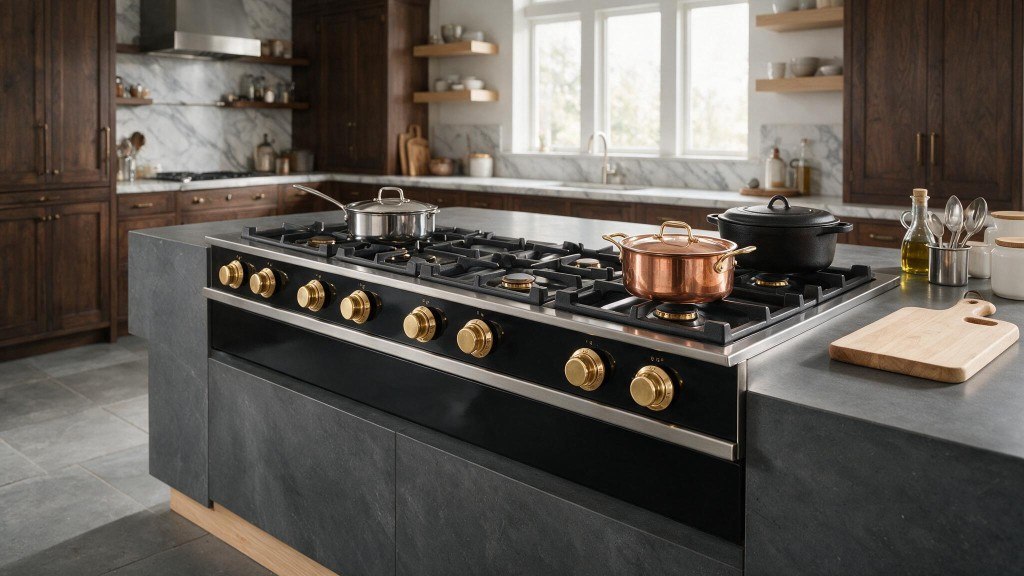
A JennAir gas rangetop that clicks but will not light needs careful, limited checks. Gas supply and cleanliness are owner territory; valve and ignition service is not.
A JennAir gas burner that clicks without a flame is most often a seating, moisture or residue problem at the burner, or a power or lockout state that stops ignition. Re-seat the cap, let any moisture dry, make sure the cooktop is not in a control lockout and try a different burner. If you smell gas, turn the burner off, ventilate and call for service.
The staccato click of spark ignition is reassuring until no blue flame follows. On JennAir rangetops integrated into stone counters, the fault feels urgent—and rightly demands respect for gas.
You can verify power to ignition and basic burner cap seating. Beyond that, gas valves and orifice work belong to qualified technicians—not online tutorials.
Clicking only proves that a spark is being produced. It does not prove gas is reaching the burner, which is why the pattern around the clicking matters.
Each burner combines gas valve, orifice, igniter electrode, and flame sensor. Misaligned caps block gas flow while spark still fires—looks like ignition failure, acts like assembly error.
Spill residue clogs igniter gaps and flash tubes. Luxury kitchens boil over too; dried sugar is a notorious ignition blocker on high-BTU burners.
Power loss to the spark module silences all burners; partial failure often affects one burner while others light normally.
The manufacturer’s help for burners that click but do not light begins with several owner-visible causes. A Control Lockout may be active after a power loss, and holding the lock key for three seconds unlocks it. Moisture from cleaning or spills in the burner ports or switches can prevent lighting, so let it dry. A cool hair dryer can help dry the area.
The same page says clogged ports should be cleaned with a straight pin, not a wooden toothpick. On first use, turning on any one burner releases air from the gas lines, and if all burners fail, you should confirm that the gas shut-off is on.
| Pattern | Likely cause | Safe owner step |
|---|---|---|
| Clicks, no smell | Cap misalignment or electrode gap | Re-seat cap and ring per manual |
| Smell, no flame | Delayed ignition risk | Shut burner; ventilate; call service |
| All burners fail | Power or module | Check breaker and outlet if applicable |
If you smell unburned gas without flame, turn off the burner control, ventilate, and do not keep clicking ignition. Persistent gas odor means leave the area and call for service from outside if needed.
Never disassemble gas valves, orifices, or regulators. Never use open flame to test for leaks.
Safe to try
Leave to a technician
If the rangetop has a downdraft, airflow can be part of the story. The manufacturer says a downdraft can blow the flame away from the igniter, causing continuous sparking, and suggests lowering the blower speed or raising the flame setting. A burner that sparks only when the downdraft is running is a useful observation.
That is also a reason to test with the downdraft off. If the burner lights normally without it, airflow rather than ignition is the cause, and the model’s manual explains how its controls interact.
After a pasta boil-over, one burner fails while neighbors work—cleaning first, parts second. All burners failing after install points to power or supply valve issues upstream.
Intermittent lights that blow out on low simmer may be sensor or venting topics for technicians familiar with JennAir simmer settings.
If clicks continue without flame and gas odor is present, turn the knob off—do not treat endless spark as harmless background noise.
The safe response is the same whether or not the odor is faint. Turn the control off, ventilate and keep ignition sources away, and do not attempt another light until the cause is understood.
Technicians leak-test fittings, measure gas pressure, inspect valves and igniters with proper tools, and verify venting on downdraft-adjacent rangetops.
Gas deserves humility. Seat the caps, clean gently, ventilate if odor appears—and hand off everything inside the valve path to someone trained for flame.
Common owner-visible causes are a cap that is not seated, moisture or residue in the burner ports, or a control lockout after a power loss. If one burner fails while the others light, cleaning and re-seating come first.
It is a feature that can be active after a power loss, and the manufacturer says holding the lock key for three seconds releases it. The manual for your model shows where the key is.
Not if you smell gas. Turn the burner off, ventilate and call for service, and do not keep clicking the ignition.
The manufacturer advises a straight pin, not a wooden toothpick, for clogged ports. Do not poke at orifices or gas fittings.
Official manuals and support notes are available on JennAir owner support.
Write down the full model number before ordering parts. Board and sensor revisions can change which part number is correct.
A single power reset can clear a temporary fault, but repeated returns of the same code usually mean a physical cause remains.
Keep vents and filters clear between visits. Restricted airflow often mimics electrical or sensor failures.
If water, burning smells, or sparking are present, stop using the appliance and arrange a professional inspection.
Not recommended on modern sealed burners—risk and design discourage it.
Often cap alignment or localized clog versus system gas failure.
Less immediate risk than gas without flame—still diagnose promptly.
No—orifice damage changes gas flow dangerously.
Why Your JennAir Refrigerator Is Not Cooling is easier to diagnose when the symptom is described in operating terms rather than reduced…
Continue readingWarm sodas in a JennAir beverage center usually mean airflow, loading, or control issues—not a reason to overhaul a built-in bar column…
Continue readingWhen a JennAir wine column creeps warm or swings cold, stability—not brute force cooling—protects bottles and reveals the real fault.
Continue readingShare a few details and we’ll confirm an appointment. Prefer to talk? Call us and we’ll help right away.