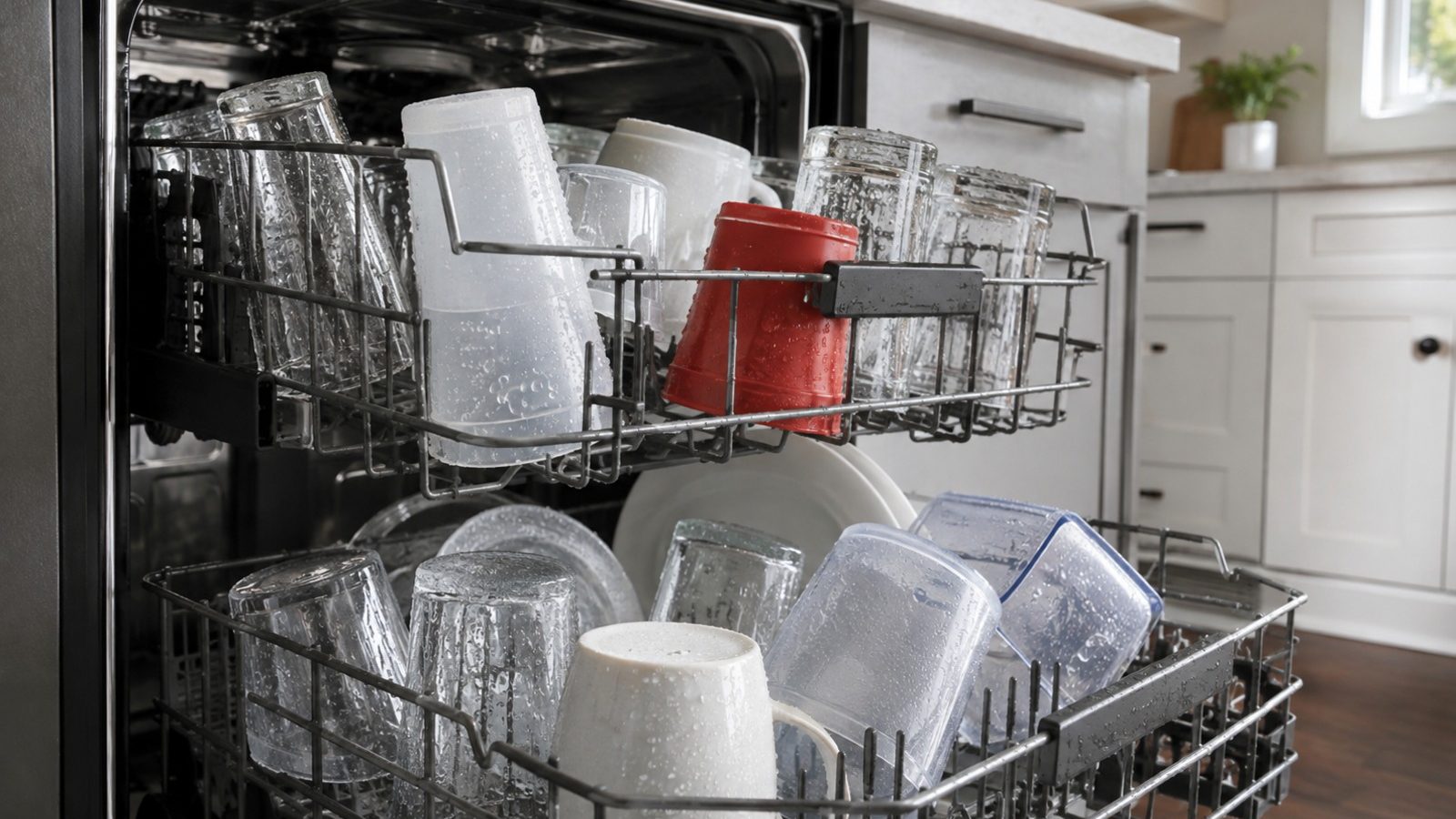

When a JennAir integrated dishwasher finishes quiet but glasses look cloudy, the story is usually spray, chemistry, or loading—not a dead motor.
Luxury dishwashers promise invisible performance behind a matching panel. Residue on wine stems breaks the spell—and rarely means the machine never tried.
Cleaning performance is a triangle: water must reach every surface, detergents must activate, and soil must drain away. Weakness in any leg looks like the same dirty glass.
Spray arms spin on low-pressure jets fed by a sump heater and wash pump. Blocked arm holes or a stuck arm starve the top rack while the bottom looks pristine.
Hard water leaves filming even when mechanical action works. Integrated kitchens often skip softeners, so rinse aid and detergent choice matter more than brand prestige.
Overloading with bulky serving pieces blocks the detergent door from opening fully—detergent never enters the party.
| Residue type | Common cause | Try this first |
|---|---|---|
| Cloudy glasses | Hard water film | Refill rinse aid; use high-temp wash |
| Food specks on plastics | Blocked spray arm | Inspect lower arm holes and spin |
| Greasy film on all items | Detergent door blocked | Reload with door clearance |
Run an empty hot cycle with dishwasher cleaner approved for stainless interiors—never oven cleaner or bleach mixes unless the manual explicitly allows.
Verify incoming water temperature at the sink nearest the dishwasher; lukewarm supply defeats enzymes before the cycle starts.
Safe to try
Leave to a technician
Top-rack-only problems often mean upper spray arm feed is clogged or the middle arm no longer connects on certain rack heights—common after hosting with tall stemware.
Uniform filming on every item screams water chemistry; localized specks scream spray geometry.
After a cycle, if the detergent cup is still closed or half full, cleaning never started chemically—even if spray ran.
Technicians measure inlet temperature, wash pump pressure, and diverter operation on multi-arm systems. Water softening recommendations may follow—not board swaps.
We confirm rack accessories are genuine; third-party tines can block spray paths unique to JennAir tubs.
Clean results belong to mechanics and chemistry together. Tune what you load and what you pour; call when spray and heat tests show the hardware side slipping.
This article covers Film And Soil Left with practical checks you can run before booking a technician.
Official manuals and support notes are available on JennAir owner support.
Remember: Film And Soil Left is easier to resolve when you capture the model number and when Film And Soil Left first appeared.
Write down the full model number before ordering parts. Board and sensor revisions can change which part number is correct.
A single power reset can clear a temporary fault, but repeated returns of the same code usually mean a physical cause remains.
Keep vents and filters clear between visits. Restricted airflow often mimics electrical or sensor failures.
If water, burning smells, or sparking are present, stop using the appliance and arrange a professional inspection.
Not always—try rinse aid and hotter water before assuming damage.
Either works if fresh; pods fail when doors cannot open.
Yes—dishwashers rely on hot fill; run sink hot first.
Scrape solids; full pre-rinse wastes water and can confuse soil sensors on some models.
Warm sodas in a JennAir beverage center usually mean airflow, loading, or control issues—not a reason to overhaul a built-in bar column…
Continue readingWhen a JennAir wine column creeps warm or swings cold, stability—not brute force cooling—protects bottles and reveals the real fault.
Continue readingWhen a JennAir ventilation hood sounds powerful yet smoke lingers, filters, duct runs, and fan health—not button labels—deserve scrutiny.
Continue readingShare a few details and we’ll confirm an appointment. Prefer to talk? Call us and we’ll help right away.