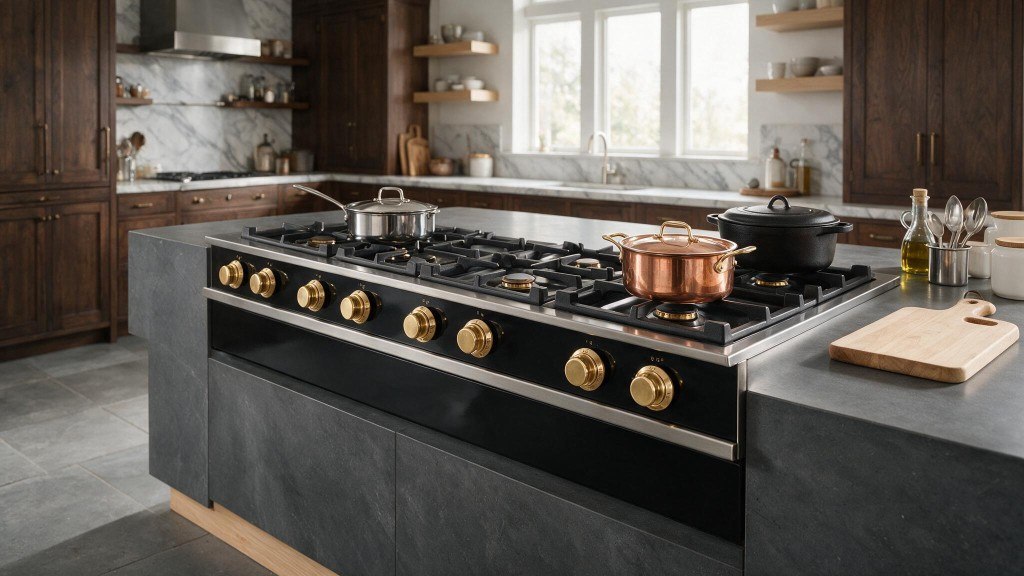

A JennAir gas rangetop that clicks but will not light needs careful, limited checks. Gas supply and cleanliness are owner territory; valve and ignition service is not.
The staccato click of spark ignition is reassuring until no blue flame follows. On JennAir rangetops integrated into stone counters, the fault feels urgent—and rightly demands respect for gas.
You can verify power to ignition and basic burner cap seating. Beyond that, gas valves and orifice work belong to qualified technicians—not online tutorials.
Each burner combines gas valve, orifice, igniter electrode, and flame sensor. Misaligned caps block gas flow while spark still fires—looks like ignition failure, acts like assembly error.
Spill residue clogs igniter gaps and flash tubes. Luxury kitchens boil over too; dried sugar is a notorious ignition blocker on high-BTU burners.
Power loss to the spark module silences all burners; partial failure often affects one burner while others light normally.
| Pattern | Likely cause | Safe owner step |
|---|---|---|
| Clicks, no smell | Cap misalignment or electrode gap | Re-seat cap and ring per manual |
| Smell, no flame | Delayed ignition risk | Shut burner; ventilate; call service |
| All burners fail | Power or module | Check breaker and outlet if applicable |
If you smell unburned gas without flame, turn off the burner control, ventilate, and do not keep clicking ignition. Persistent gas odor means leave the area and call for service from outside if needed.
Never disassemble gas valves, orifices, or regulators. Never use open flame to test for leaks.
Safe to try
Leave to a technician
After a pasta boil-over, one burner fails while neighbors work—cleaning first, parts second. All burners failing after install points to power or supply valve issues upstream.
Intermittent lights that blow out on low simmer may be sensor or venting topics for technicians familiar with JennAir simmer settings.
If clicks continue without flame and gas odor is present, turn the knob off—do not treat endless spark as harmless background noise.
Technicians leak-test fittings, measure gas pressure, inspect valves and igniters with proper tools, and verify venting on downdraft-adjacent rangetops.
Independent service is appropriate; authorization is not required—competence and licensing are.
Gas deserves humility. Seat the caps, clean gently, ventilate if odor appears—and hand off everything inside the valve path to someone trained for flame.
This article covers Jennair Gas Rangetop Burner with practical checks you can run before booking a technician.
Official manuals and support notes are available on JennAir owner support.
Remember: Jennair Gas Rangetop Burner is easier to resolve when you capture the model number and when Jennair Gas Rangetop Burner first appeared.
Write down the full model number before ordering parts. Board and sensor revisions can change which part number is correct.
A single power reset can clear a temporary fault, but repeated returns of the same code usually mean a physical cause remains.
Keep vents and filters clear between visits. Restricted airflow often mimics electrical or sensor failures.
If water, burning smells, or sparking are present, stop using the appliance and arrange a professional inspection.
Not recommended on modern sealed burners—risk and design discourage it.
Often cap alignment or localized clog versus system gas failure.
Less immediate risk than gas without flame—still diagnose promptly.
No—orifice damage changes gas flow dangerously.
Warm sodas in a JennAir beverage center usually mean airflow, loading, or control issues—not a reason to overhaul a built-in bar column…
Continue readingWhen a JennAir wine column creeps warm or swings cold, stability—not brute force cooling—protects bottles and reveals the real fault.
Continue readingWhen a JennAir ventilation hood sounds powerful yet smoke lingers, filters, duct runs, and fan health—not button labels—deserve scrutiny.
Continue readingShare a few details and we’ll confirm an appointment. Prefer to talk? Call us and we’ll help right away.